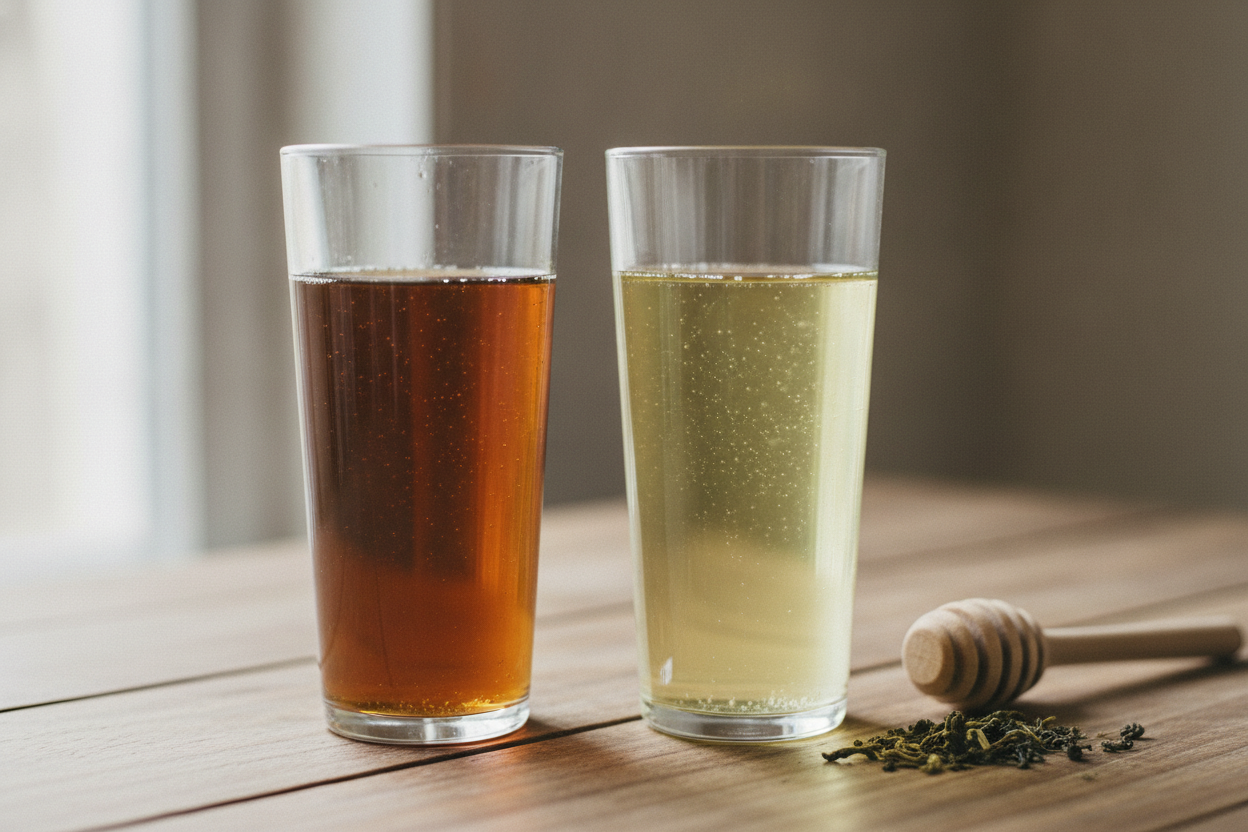
Jun tea vs kombucha is one of the questions we hear most from people who have tried one and want to know about the other. The short answer is that they are close cousins made with the same kind of living culture, and the real differences come from the tea, the sweetener and the way each is raised. This guide sets out jun tea vs kombucha side by side, with what we could verify and what we could not.
We brew both, so we are not neutral. If jun is new to you, start with what is jun tea. We sell jun tea Singapore and kombucha Singapore, and we say which statements are our own and have not been independently audited. Where the research is thin, we say so rather than fill the gap with confident claims.
TL;DR: Jun tea vs kombucha comes down to ingredients: jun is typically made with green tea and honey, while kombucha is typically made with black tea and cane sugar. Both are fermented with a culture of bacteria and yeast, so both are tart, lightly fizzy, contain a little caffeine and a trace of alcohol. We found no human trial of jun, so we cannot say that either one is healthier. Pick on taste, price and how you react to honey.
Table of contents
Jun tea vs kombucha in one minute
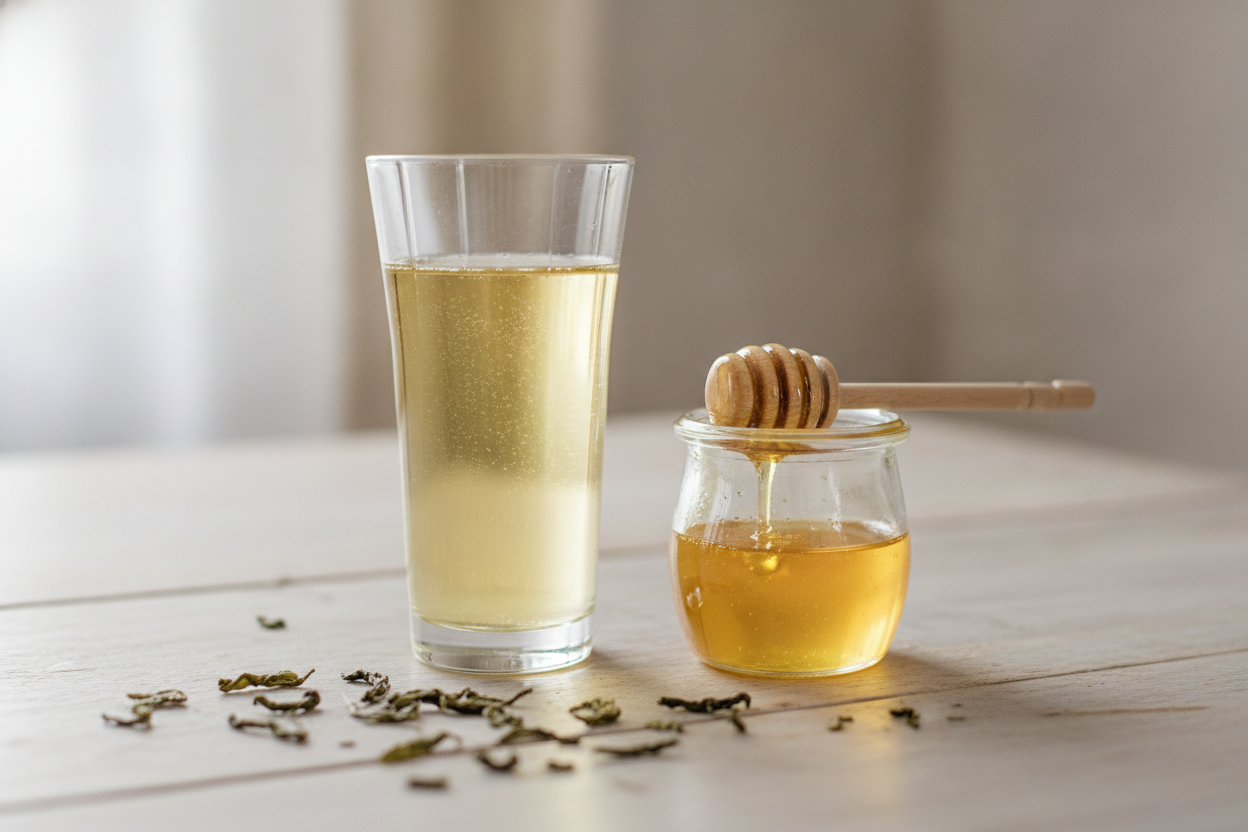
If you only read one section, read this one. The Wikipedia entry on jun describes it as a fermented drink similar to kombucha, differing in that its base ingredients are green tea and honey instead of black tea and cane sugar. Both are fermented with a symbiotic culture of bacteria and yeast, usually called a SCOBY.
- Base: jun uses green tea and honey; kombucha usually uses black tea and sugar.
- Taste: sources disagree on which is sweeter, so check the bottle and the brewer's own description.
- Caffeine: both start from real tea, so both contain some.
- Alcohol: both contain a trace from fermentation; neither is guaranteed alcohol-free.
- Price: jun usually costs more, because honey costs more and brewers make less of it.
- Evidence: the research is on kombucha and on ingredients, not on jun itself.
The rest of this guide expands each point. The point of looking at jun tea vs kombucha is not to crown a winner. It is to choose the bottle that suits your palate, your budget and your health situation.
Jun tea vs kombucha: ingredients and the culture
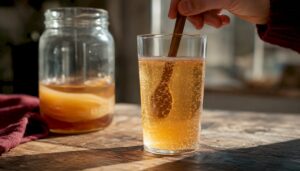
Every comparison of jun tea vs kombucha starts with the ingredient list. The Wikipedia entry on jun says jun is composed primarily of green tea and honey, whereas kombucha is made of black tea and cane sugar, and that both need a symbiotic colony of bacteria and yeast.
That sounds like a small change, but it changes the food for the culture. In the 2023 study in Foods on kombucha made with a Greek mountain tea sweetened with thyme honey, the authors explain that honey is mainly fructose and glucose, while table sugar is sucrose. Yeasts first break sucrose down into glucose and fructose. In honey those sugars are already available, so the acetic acid bacteria can get going sooner, and in that study the bacteria grew faster than the yeasts.
That is a lab study of a different tea, not of jun, and it should not be read as a rule for every jun on a shelf. It does show why the honey base is more than a flavour choice. It is also a reason to expect that jun tea vs kombucha will differ in how they ferment, not only in how they taste.
Brewers also differ in what they add after fermentation. Fruit, ginger, flowers and spices are common in both. When you compare jun tea vs kombucha in a shop, compare like with like: an unflavoured jun against an unflavoured kombucha tells you far more than a fruity one against a plain one.
Green tea or black tea: does the tea matter?
It does, according to the lab work we could read. A 2018 study in Nutrients that fermented green, black and rooibos tea with the same starter culture found that the bacterial community was similar across the teas, dominated by Komagataeibacter, but the yeast community was significantly different depending on the tea. The authors read that as the substrate shaping the microbes that ferment it.
A 2020 study in Antioxidants on white, green, black and red tea kombucha reported that the type of tea has a significant influence on antioxidant potential, pH, and the content of acetic acid, alcohol and sugar. It also reported that red tea and green tea were particularly prominent sources of antioxidants, especially polyphenols, on the first and fourteenth day of fermentation.
Both studies are about kombucha, and neither used honey as the sweetener. So they support one limited point: the tea changes the drink. They do not tell us that jun beats kombucha, or the reverse. Anyone who claims they do is going beyond what these papers show.
Jun tea vs kombucha taste: what to expect
Taste is the question most people actually care about when they search for jun tea vs kombucha taste, and it is the one where sources disagree. The Wikipedia entry says jun has a sweeter taste. Our own page describes our jun as lighter, drier and softer than kombucha, closer to a dry sparkling wine.
Both can be true, because sweetness depends on how long the drink is fermented and what was added afterwards. A jun stopped early will taste sweeter. One left longer will taste drier and more tart. The same is true of kombucha. That is why we hesitate to give a single answer to jun tea vs kombucha taste.
Here is a practical way to judge. Pour each into a clear glass, smell first, then taste a small sip. Honey-based drinks often smell rounder and more floral, while black-tea drinks often smell darker and maltier. Those are general impressions, not measurements, and a flavoured bottle will mask both.
Sugar and calories: jun tea vs kombucha
Honey is a sugar, and the culture eats some of it. How much is left in the bottle depends on the brewer, the batch and the time. We did not find a published, like-for-like measurement of sugar in jun against kombucha, so we cannot give you a number for jun tea vs kombucha that applies to every brand.
What we can say is what our own panels state. Across our range, we state about 1 to 3 per cent sugar and a Nutri-Grade of A or B. That is our own statement, it has not been independently audited, and it covers both our jun and our kombucha. For how to read those figures on any bottle, see our guide to kombucha calories.
If sugar matters to you, the label is more useful than the category. Check grams per 100 mL where the label gives them. A drink called jun is not automatically lower in sugar than one called kombucha, and the reverse is equally true.
Caffeine and alcohol: jun tea vs kombucha
Both start with real tea, so both contain some caffeine. Our own jun page says a little caffeine comes from the green tea. We did not find a measurement of caffeine in jun, so we do not claim that jun tea vs kombucha differs on caffeine in either direction. Our guide to kombucha caffeine explains why numbers vary.
Alcohol is the other common question. Fermentation makes some ethanol in both. A 2022 laboratory study of nine commercial kombucha products detected ethanol in eight of nine products, up to 1.29 per cent in one. A Swiss cantonal laboratory report from Basel-Stadt measured 0.2 to 0.9 per cent by volume in 12 kombucha drinks, with six above 0.5 per cent.
Those studies tested kombucha, not jun. Our own stated figure for our drinks is under 0.5 per cent ABV, and that has not been independently audited. For a plain explanation, read kombucha and alcohol. The safe assumption in jun tea vs kombucha is the same for both: not zero. For jun specifically, see does jun kombucha have alcohol.
Is jun a healthy drink? What the evidence does and does not show
This is the question we most want to answer carefully. People often ask whether jun is healthier than kombucha, or whether jun is a healthy drink at all. We searched Europe PMC, the open index of biomedical research, for studies on jun and found no human trial of jun. We cannot tell you that jun is healthier than kombucha.
What exists is research on the ingredients and on kombucha. The studies above show that tea type changes the chemistry of the drink, and the honey study shows that honey-sweetened kombucha can ferment. None of them measured health outcomes in people drinking jun. A change in antioxidant readings in a lab is not the same as a benefit to you.
So our honest position on jun tea vs kombucha is this. Both are foods, not medicines. Neither is proven to treat or prevent anything. If a seller tells you jun is a cure, or that jun tea vs kombucha has a clear health winner, ask for the study. Our guide to kombucha side effects covers who should be careful.
Who should be careful with honey-based jun
Honey changes who should think twice. Our own jun page says it is made with honey and is not suitable for infants under 12 months. The same page advises people who are pregnant, immunocompromised or unsure to ask a doctor first. We repeat that here because it is a real difference in jun tea vs kombucha for some households.
Medicines are the second group. Fermented drinks can interact with some prescriptions, and we do not know of studies specific to jun. If you take regular medication, read our guide to kombucha and medication interactions and ask your pharmacist. The sensible rule is the same whichever side of jun tea vs kombucha you choose.
Finally, if you are new to fermented drinks, start with a small glass and see how you feel before drinking more. That is general caution, not medical advice, and it applies equally to both.
Price and availability: why jun usually costs more
The Wikipedia entry says jun has a higher price, because of the cost of its ingredients, and limited availability. That matches our experience. Our own page says jun ferments cooler and takes longer, so we make less of it, which is why it is rarer and a little dearer.
On our shelf the numbers are simple. Our jun is $7.50 a bottle and our kombucha is $6.80, a difference of 70 cents. A case of 12 comes to $90.00 for jun or $81.60 for kombucha. Those totals are our own arithmetic from our listed prices, and prices can change, so check the shop before you order.
Delivery is free on orders of $80 and above, about 12 bottles, and on every subscription. Both cases above clear that line. For the wider picture, compare kombucha delivery in Singapore options before you decide.
Where jun came from, and the champagne of kombucha label
You will often see jun called the champagne of kombucha. The label is a marketing line, not a technical category, and it says more about how brewers want you to see it than about what is in the bottle. We use it only because you will meet it when you shop.
The origin story is also contested. The Wikipedia entry notes that Western vendors claim jun was developed thousands of years ago by monks in Tibet and northern China, and quotes the food writer Sandor Katz, who doubts this and sees jun as a relatively recent offshoot of the kombucha family tree. We are repeating what that page reports, not ruling on the history.
Our own page labels the Himalayan story as folklore, and we treat it that way. For jun tea vs kombucha, the history is a nice story but it should not decide what you buy. Taste, price and tolerance matter more than a legend about a mountain.
Jun tea vs kombucha: which one should you pick?
Here is a simple, honest way to choose. These are our own rules of thumb, not research findings, and you should adjust them to your situation.
- You like a lighter, floral style: try jun first, and judge it against an unflavoured kombucha.
- You like a darker, tart, tea-forward drink: start with kombucha.
- You watch your budget: kombucha usually costs less per bottle.
- You avoid honey for any reason: choose kombucha and check its ingredient list.
- You are curious: buy one of each and compare them chilled, side by side.
If you are still undecided, the cheapest answer to jun tea vs kombucha is to taste both. A single bottle of each tells you more than any article, including this one.
How our own jun and kombucha compare
Aboocha brews kombucha and jun tea in small batches in Singapore. These are our own statements and have not been audited by an independent party.
| Item | Our jun | Our kombucha |
|---|---|---|
| Live culture | Raw and unpasteurised | Raw and unpasteurised |
| Base we state | Filtered water, green tea, raw unpasteurised honey from a single apiary, our jun mother, real fruit or root | See each product page |
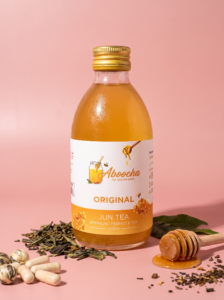
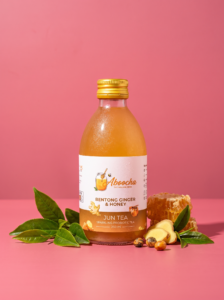
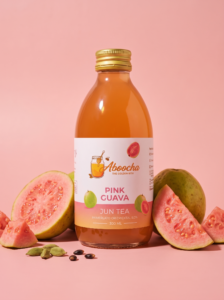
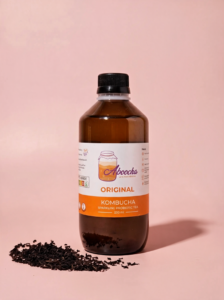
| Flavours | Four: Original, Bentong Ginger and Honey, Raspberry and Lemon, Pink Guava | Eight, including Original, Sour Plum and Yuzu Osmanthus |
| Price per bottle | $7.50 | $6.80 |
| Sugar | About 1-3%, Nutri-Grade A-B, per our panels | About 1-3%, Nutri-Grade A-B, per our panels |
| Alcohol | Under 0.5% ABV, our own stated figure | Under 0.5% ABV, our own stated figure |
You can browse the Jun Original and Pink Guava Jun, or the Original kombucha, or see everything in the shop. For the full range of flavours, visit jun tea Singapore and kombucha Singapore.
Storage is the same for both
Whichever side of jun tea vs kombucha you choose, raw bottles keep fermenting while warm. That means more fizz, more tartness and possibly more alcohol if they sit out. Keep them chilled, drink them within the date and open them carefully.
Our guide on whether kombucha needs refrigeration explains the reasoning, and it applies to a raw jun as well. Pasteurised bottles are different and are handled differently, so read the label for the storage line.
Trying jun tea vs kombucha side by side in Singapore
The easiest test of jun tea vs kombucha is a mixed order. A case of 12 lets you try several flavours of each. Chill them, pour small glasses, and write down which you finish first. That tells you more about your own taste than any comparison.
If you would rather not decide at all, our subscription lets you mix any flavours across kombucha and jun tea. Our page says subscribers save 15 per cent and never pay delivery, and that statement is our own. See the shop for current options.
Common mistakes when comparing jun tea vs kombucha
- Comparing a flavoured bottle with a plain one: the flavour hides the base.
- Treating the culture as the difference: both use a SCOBY; the tea and sweetener differ.
- Assuming jun has no caffeine or no alcohol: both contain some.
- Believing a health winner exists: we found no human trial of jun.
- Ignoring honey: it matters for infants and some medical conditions.
Avoiding these keeps the jun tea vs kombucha decision simple and honest.
What we checked and what we could not
- Checked: the Wikipedia entry on jun, the 2018 Nutrients study, the 2020 Antioxidants study, the 2023 Foods study on honey-sweetened kombucha, the 2022 laboratory study of nine commercial kombucha products and the Basel-Stadt report.
- Could not find: a human trial of jun, a published like-for-like comparison of sugar or caffeine in jun against kombucha, and an independent measurement of our own products.
- Our own statements: everything in the Aboocha table, including prices, sugar and alcohol.
This article is general information, not medical advice. If you have a health condition or take medication, talk to a doctor or pharmacist before changing what you drink.
Are jun tea and kombucha the same?
They are close relatives. Both are fermented with a culture of bacteria and yeast. Jun is typically made with green tea and honey, and kombucha with black tea and cane sugar, so jun tea vs kombucha is mostly a difference in ingredients and flavour.
What is the real difference in jun tea vs kombucha?
The base. Jun uses green tea and honey, and kombucha usually uses black tea and sugar. Brewers also differ in fermentation time, flavouring and price, so the differences between brands can be larger than the differences between the two categories.
Is there alcohol in jun kombucha?
Yes, a trace, as with kombucha. Fermentation produces some ethanol. Lab studies of kombucha found 0.2 to 1.29 per cent in different samples. Our own stated figure for our jun and kombucha is under 0.5 per cent ABV, which has not been independently audited.
Is jun a healthy drink?
We cannot say it is healthier than kombucha. We found no human trial of jun. It is a food, not a medicine, and it contains honey, caffeine and a trace of alcohol. People who are pregnant or take medication should ask a doctor first.
Does jun tea have caffeine?
Yes, a little, because it is brewed from green tea. We did not find a measurement for jun, so we do not claim that jun tea vs kombucha differs on caffeine. Amounts vary by recipe and brew.
Which is sweeter in jun tea vs kombucha taste?
Sources disagree. Wikipedia says jun is sweeter, while our own jun is lighter and drier. Sweetness depends on fermentation time and any added flavourings, so check the label and taste a small glass.
Should I try jun tea vs kombucha first if I am new to fermented drinks?
Either works. Start with a small glass, chilled, and see how you feel. If you take regular medication, read our guide on kombucha and medication interactions and ask your pharmacist first.
Where can I buy jun tea in Singapore?
We sell four jun flavours at $7.50 a bottle with free delivery on orders of $80 and above. Visit our jun tea Singapore page or the shop. Check each brand's label for ingredients and storage before you buy.