Jun tea benefits are talked about everywhere, and almost always with more confidence than the evidence allows. We searched the research for trials of jun itself and found none. What exists is research on its ingredients, green tea and honey, and on fermented foods and kombucha. This guide sets out what that research shows, what it does not, and how to read any claim about jun tea benefits.
We brew jun in Singapore, so we are not neutral. We sell jun tea Singapore and kombucha Singapore, and we label which statements are our own and have not been independently audited. If you are new to the drink, start with what is jun tea, then come back here.
TL;DR: Jun tea benefits have not been tested in human trials that we could find. The research is about green tea, honey and fermented foods in general, and much of it is from cell, animal or small studies. Two 2026 trials of green tea kombucha, which is not jun, gave mixed and limited results. So we do not claim jun is healthy, or healthier than kombucha. Treat it as a flavourful fermented drink, and ask a doctor if you are pregnant, immunocompromised or on medication.
Table of contents
Jun tea benefits: the short answer
If you only read one section, read this one. These are the points that matter most when judging jun tea benefits:
- No jun trials: we found no human trial of jun, so no jun tea benefits are proven.
- Ingredient research: studies of green tea and honey are mostly lab, animal or small human studies.
- Kombucha trials: two 2026 trials of green tea kombucha gave limited, mixed results.
- Live cultures are not probiotics: an expert panel says products should not be labelled probiotic without strain-level evidence.
- Caution: honey is unsuitable for infants, and jun contains caffeine and a trace of alcohol.
The sections below take each of the common jun tea benefits claims in turn, so you can see what sits behind it.
What jun tea benefits claims are based on
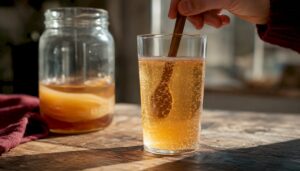
The Wikipedia entry on jun describes jun as green tea sweetened with honey and fermented with a bacteria-and-yeast culture. Most jun tea benefits claims borrow from its parts: green tea for antioxidants, honey for gut bacteria and the culture for probiotics.
That is a reasonable starting point for a hypothesis, but it is not evidence that the finished drink does any of those things. Fermentation changes the ingredients, and the amount of each compound in a bottle varies. A claim about green tea in a cup is not automatically a claim about a fermented drink.
So when we look at jun tea benefits, we ask three questions each time. What was actually tested, in what, and in whom? The answers are usually: a compound or ingredient, in a lab or a small group, and rarely in jun.
Green tea and jun tea benefits
Jun is brewed on green tea, and green tea has a large research literature. A 2018 review of tea polyphenols in Nutrients reports that catechins such as EGCG are the main polyphenols in green tea. It says there is numerous evidence from cell culture and animal studies that tea polyphenols have beneficial effects against several diseases.
Note the wording: cell culture and animal studies. That is a different thing from showing that a drink helps people. The review summarises that research and we are not disputing it, but it does not tell us what a bottle of fermented green tea and honey does for a person.
The tea also changes the ferment. A 2018 study in Nutrients that compared green, black and rooibos kombucha found that the yeast community differed significantly depending on the tea. So the green tea in jun is not just a source of antioxidants. It shapes what grows, which is one reason jun tea benefits cannot simply be read across from kombucha made with black tea.
Honey and jun tea benefits
Honey is the other half of jun. A 2022 review of honey as a prebiotic food in Frontiers in Nutrition says that evidence from in vitro, animal and pilot human studies suggests some kinds of honey have prebiotic activity. Prebiotics are compounds that can favour certain gut bacteria. The authors also say there are gaps in knowledge.
Two cautions apply to jun tea benefits. First, the studies are about certain honeys, not necessarily the honey in a given bottle. Second, the culture consumes sugars during fermentation. We do not know how much of any prebiotic compound survives in jun, and we found no analysis of that.
Honey is still a sugar. A 2023 study in Foods of kombucha made with mountain tea and thyme honey explains that honey is mainly fructose and glucose, and that the culture grew on it. That study also found higher phenolics and antioxidant activity after fermentation. These were laboratory measurements of a mountain tea, not a health outcome in people.
Are jun tea benefits "probiotic"? Live cultures explained
Probiotic is the word most often attached to jun tea benefits, and it needs care. An 2021 consensus statement on fermented foods from ISAPP lists most kombuchas among fermented foods that contain live microorganisms, and says non-heated fermented foods typically do. That fits a raw jun.
But the same panel says fermented foods should not be labelled as containing probiotics without strain-level characterisation, and that the microbes are mostly chosen for performance, not for health. So live cultures are not the same as a proven probiotic. We found no analysis of the microbes in jun, so we cannot name them or claim a health effect.
Our own jun page says raw jun carries the living yeasts and bacteria of its ferment. We stand by that as a description of our product, and it has not been independently audited. It is a statement about live cultures, not a claim that they improve your gut.
What trials of kombucha show about jun tea benefits
Because jun has no trials, the closest evidence is trials of kombucha made with green tea. Two came out in 2026. Neither used honey, and neither is a trial of jun, so they bear on jun tea benefits only by analogy.
The first is a 2026 randomised trial of green tea kombucha in people with excess weight. It gave 59 people 200 mL of green tea kombucha a day for 10 weeks alongside a calorie-restricted diet. The kombucha group had lower cholesterol, LDL, triglycerides and uric acid than at the start. Against the control group, the authors highlight only one difference: glycated haemoglobin in men.
That trial used kombucha sweetened with 50 grams of sugar per litre, was not blinded, and compared mostly with baseline. It is encouraging, but it is a small trial in people with excess weight. The authors call the findings promising, and we would add that it needs repeating.
The second is a 2026 randomised trial in beginner runners of 90 healthy adults over 12 weeks. Green tea kombucha did not change the primary outcome, a measure of antioxidant capacity, and the authors describe other changes as exploratory. In plain terms, it did not show a clear benefit.
Fermented foods, the gut and jun tea benefits
A third piece of evidence is about fermented foods as a group. The 2021 randomised trial in Cell followed healthy adults for 17 weeks, with 18 people in each diet arm. The high-fermented-food group steadily increased microbiome diversity and decreased inflammatory markers, which the authors describe as diet-specific effects.
Look at what that diet was. Participants averaged about 6.3 servings of fermented food a day, from categories including yoghurt, kefir, fermented vegetables and kombucha. It was a mixed diet, not a single drink, and it was not jun. You cannot read the result as a number for jun tea benefits.
Still, it is the best human evidence in this area, and it points in a favourable direction for fermented foods overall. We would say it supports eating a varied diet that includes fermented foods, not drinking jun in particular.
Jun tea benefits claims, checked
Here is how the common claims line up against what we found. The strength column is our own judgement of the sources above, not a formal grading.
| Claim | What we found | Strength for jun |
|---|---|---|
| Antioxidants | Green tea research is mostly cell and animal studies; lab antioxidant measures rise in some ferments | Weak: no jun measurement found |
| Gut health | A mixed fermented-food diet raised microbiome diversity in 36 healthy adults | Weak: not jun, not a single drink |
| Probiotics | Raw kombucha has live microbes, but no strain-level evidence of probiotic effect | Weak: no jun analysis found |
| Prebiotic honey | Some honeys show prebiotic activity in lab, animal and pilot studies | Weak: unknown what survives fermentation |
| Cholesterol and uric acid | One small kombucha trial showed changes from baseline | Weak: kombucha, not jun |
| Immunity or exercise | One kombucha trial showed no clear benefit | None shown |
Every row says weak or none, which is the honest picture for jun tea benefits today. That is not a claim that jun does nothing. It is a statement that nobody has tested it well.
Jun tea benefits versus kombucha benefits
People often ask whether jun is healthier than kombucha. There is no trial comparing them, so the honest answer is that nobody knows. The two share a culture and differ in tea and sweetener, which our guide to jun tea vs kombucha explains.
The honey study and the tea-type study both show that the base matters for the ferment. That makes it plausible that jun and kombucha differ in some respects. It does not tell us which is better, or whether any difference matters for health.
Our recommendation is practical. Choose between jun and kombucha on taste, price and how you react to honey, and treat any claim that one has clearly better benefits with suspicion.
Who should be careful with jun tea
Benefits aside, a few cautions come from our own product pages. Honey is not suitable for infants under 12 months. Jun also contains a little caffeine from the green tea, and a trace of alcohol from fermentation. Our own stated figure is under 0.5 per cent ABV, which has not been independently audited. For detail, read does jun kombucha have alcohol.
If you are pregnant, immunocompromised or unsure, ask your doctor first, as our page says. If you take regular medication, read our guide to kombucha and medication interactions and ask your pharmacist. Those guides are about kombucha, and we found no study of interactions specific to jun.
For liver and kidney questions, see our guide to kombucha liver and kidney risks. The reports there involve kombucha, not jun, but the cautions about heavy intake and existing illness are sensible to keep in mind.
Our own statements about jun
Aboocha brews kombucha and jun tea in small batches in Singapore. These are our own statements and have not been audited by an independent party.
| Item | What we state for our jun |
|---|---|
| Health claims | Jun is a food, not a medicine; we do not claim it treats or prevents anything |
| Live culture | Raw and unpasteurised |
| Ingredients | Filtered water, green tea, raw unpasteurised honey from a single apiary, our jun mother, real fruit or root |
| Sugar | About 1-3%, Nutri-Grade A-B, per our nutrition panels |
| Alcohol | Trace, under 0.5% ABV, our own stated figure |
| Honey | Not suitable for infants under 12 months |
| Price per bottle | $7.50; free delivery on orders of $80 and above and on every subscription |
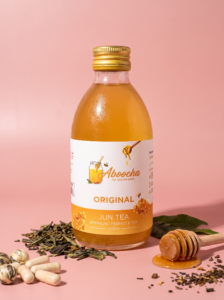
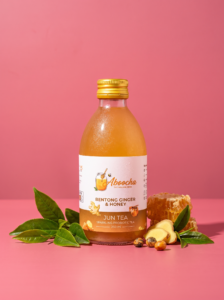
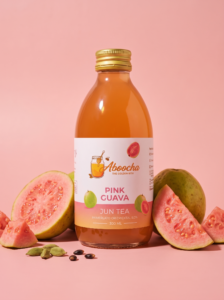
You can browse the Jun Original, Pink Guava Jun or everything in the shop. See jun tea Singapore for the full range.
How to read any jun tea benefits claim
Use these questions on any page, including ours, that lists jun tea benefits:
- Was jun tested? If the study is on green tea, honey or kombucha, it is not a jun result.
- Who was studied? Cells and animals are not people.
- How big and how long? A few dozen people for weeks is a start, not proof.
- Compared with what? Changes from baseline are weaker than differences from a control group.
- Who funds it and sells it? A brand selling the drink has an interest, including us.
If a page cannot answer these, treat its jun tea benefits as marketing, not evidence.
What we checked and what we could not
- Checked: the Wikipedia entry on jun, a 2018 tea polyphenol review, a 2022 honey prebiotic review, the 2023 honey kombucha study, the 2021 ISAPP consensus, the 2021 Cell trial, a 2018 comparison of kombucha teas and two 2026 green tea kombucha trials.
- Could not find: a human trial of jun, an analysis of the microbes or sugars in jun, and a head-to-head comparison of jun and kombucha.
- Our own statements: everything labelled as ours.
This article is general information, not medical advice. If you have a health condition or take medication, talk to a doctor or pharmacist before changing what you drink.
What are the benefits of jun tea?
No human trial of jun has tested benefits, so none are proven. Research exists on green tea, honey and fermented foods in general, mostly from lab, animal or small human studies. We treat jun as a flavourful fermented drink, not a health product.
Is jun tea good for you?
We cannot say. It is made from green tea and honey, and it contains caffeine and a trace of alcohol. We found no trial showing jun improves health. Honey is unsuitable for infants, and pregnant or immunocompromised people should ask a doctor first.
Does jun tea have probiotics?
Raw jun contains live yeasts and bacteria, as most kombuchas do. But an expert panel says fermented foods should not be labelled probiotic without strain-level evidence, and we found no analysis of the microbes in jun. So live cultures, yes; proven probiotic, no.
What are the benefits of green tea kombucha?
Two 2026 trials give a limited picture. One small trial found lower cholesterol and uric acid versus baseline alongside a calorie-restricted diet. Another found no clear change in its main outcome. Neither tested jun, and both need repeating.
Is honey better than sugar in kombucha?
We cannot say it is healthier. Honey is mainly fructose and glucose, while table sugar is sucrose, and honey grew the culture in one lab study. But honey is still sugar, and we found no trial comparing honey-fermented with sugar-fermented drinks in people.
Is jun healthier than kombucha?
Nobody knows. There is no trial comparing them. The tea and sweetener differ, which changes the ferment, but we found no evidence that either is clearly better for health. Choose on taste, price and how you react to honey.
Is jun tea safe for pregnancy or children?
Honey is not suitable for infants under 12 months. Our own page says pregnant or immunocompromised people should ask a doctor first. We found no study of jun in pregnancy, so we give no safe-amount claim for anyone.
Where can I buy jun tea in Singapore?
We sell four jun flavours at $7.50 a bottle, with free delivery on orders of $80 and above and on every subscription. Visit our jun tea Singapore page or the shop, and read each brand's label for ingredients and storage.