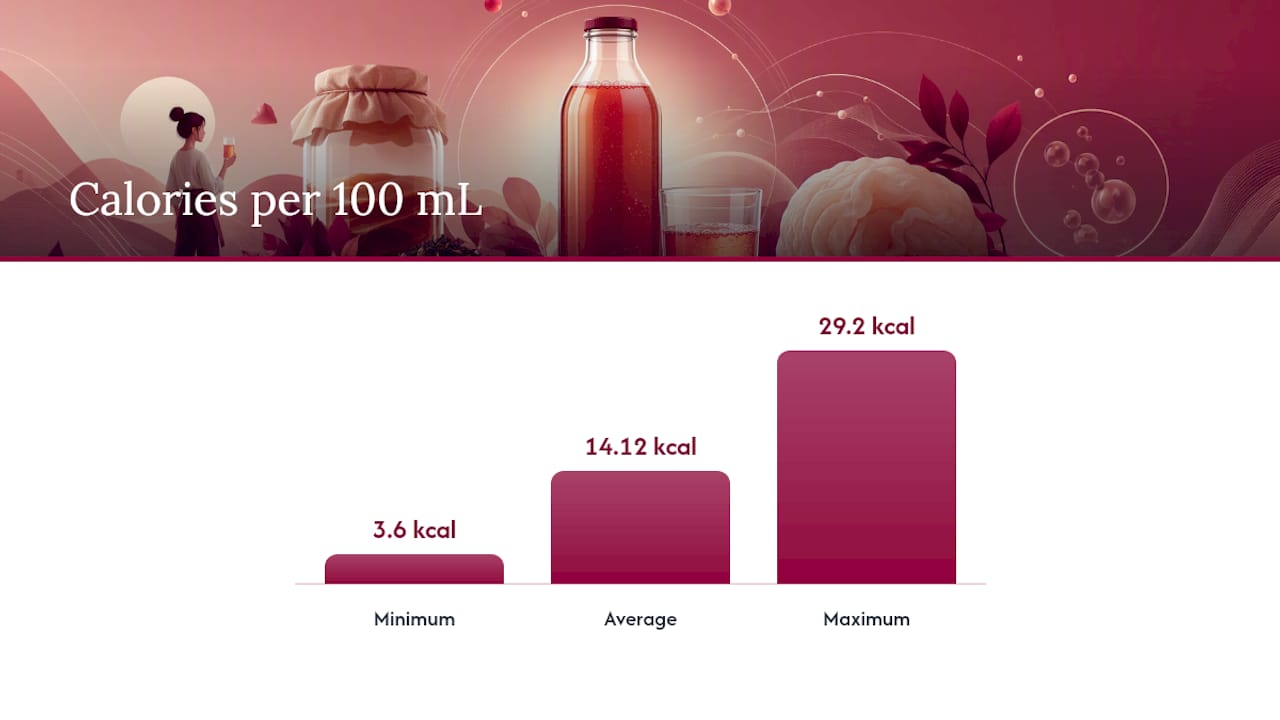
Kombucha calories are usually modest. In the 59 product labels we checked, plain and flavoured kombucha ranged from 0 to 23 kcal per 100 mL, with a middle value of 14 kcal. That is about a third of the energy in a regular cola. This guide explains kombucha calories per 100 mL, per bottle and per cup, and how to read a label.
We brew raw kombucha in Singapore, so we are not neutral. To keep this honest, we use label data that anyone can open, we say plainly where it is limited, and we leave out numbers we could not trace to a source we could read.
TL;DR: Kombucha calories in the label records we checked: a median of 14 kcal per 100 mL, a range of 0 to 23, and a median of 2.5 g of sugar per 100 mL. A 330 mL bottle at the median is about 46 kcal. Regular cola, from its own label record, is 42.4 kcal per 100 mL. Fruit, juice and serving size change the real number, so read the label per 100 mL.
Table of contents
Kombucha calories: the short answer
Most kombucha calories come from sugar that the fermentation did not use up, plus any juice or syrup added afterwards. Tea itself adds almost nothing. So kombucha calories are lowest in plain, fully fermented bottles and highest in sweet, juicy ones.
Across the label records we reviewed, the typical bottle sits well under the energy in a regular soft drink. But the spread is real. Two bottles of kombucha can differ by more than the gap between kombucha and soda. That is why the useful skill is reading the label, not memorising one number.
For a wider look at how kombucha is made and sold locally, see our guide to kombucha in Singapore. For safety questions, see kombucha side effects.
Kombucha calories per 100 mL: what 59 labels show
To get a number we can defend, we pulled kombucha products from Open Food Facts, an open, crowd-sourced database where people enter the nutrition panel printed on the pack. We took the first 60 search results, removed one record that was not a kombucha drink (a condensed milk product), and kept 59 with both energy and sugar listed. Here is what they show per 100 mL.
| Measure | Energy (kcal per 100 mL) | Sugars (g per 100 mL) |
|---|---|---|
| Lowest | 0 | 0 |
| Middle value (median) | 14 | 2.5 |
| Average (mean) | 12.2 | 2.5 |
| 90th percentile | 18 | 4.4 |
| Highest | 23 | 4.6 |
So the middle bottle holds about 14 kcal per 100 mL. Nine out of ten were at or below 18 kcal per 100 mL, and none was above 23. The sugar column tells the same story as the kombucha calories column: a middle value of 2.5 g per 100 mL, and a top value of 4.6 g.
Be careful with what this sample is. It is the first page of search results from a volunteer database, mostly European brands, with some Australian and Canadian ones. It is not a random sample, it is not a Singapore market survey, and label values are what brands report, not what we measured in a lab. Treat it as a realistic range, not a law.
Why do kombucha calories matter per 100 mL? Because it lets you compare bottles of different sizes fairly. Sizes vary, and a calorie figure quoted "per serving" can hide a smaller serving than the bottle you hold.
Kombucha calories per bottle and per cup
Once you know the per 100 mL figure, the kombucha calories in your own bottle are simple arithmetic: multiply by the volume and divide by 100. The table applies our sample values to common sizes.
| Serving | At the median (14 kcal) | At the 90th percentile (18 kcal) | At the highest we saw (23 kcal) |
|---|---|---|---|
| One cup, 240 mL | 34 | 43 | 55 |
| Small bottle, 250 mL | 35 | 45 | 58 |
| Standard bottle, 330 mL | 46 | 59 | 76 |
| Large bottle, 500 mL | 70 | 90 | 115 |
A "cup" in nutrition databases is usually about 240 mL, so one cup of typical kombucha lands in the mid-30s of calories. A full 500 mL bottle can reach 70 to 115 kcal, which is the real surprise for people who assumed every kombucha is a 30-calorie drink.
These are our calculations from the sample above, rounded to whole numbers. If your bottle lists its own value, use that instead.
Kombucha calories vs soda
The most common reason people ask about kombucha calories is to compare it with soda. We checked a soft drink the same way. The Open Food Facts record for Coca-Cola Original lists 42.4 kcal and 10.6 g of sugar per 100 mL, and a second Coca-Cola record in the same database shows 42.1 kcal and 10.6 g.
| Per 330 mL | Energy (kcal) | Sugars (g) |
|---|---|---|
| Kombucha at the sample median | 46 | 8.3 |
| Kombucha at the sample highest | 76 | 15.2 |
| Coca-Cola Original (label record) | 140 | 35 |
The gap is large at the median: about 46 kcal against about 140 kcal for the same volume. But the highest kombucha in the sample, at 76 kcal, is more than half the energy of the cola. So "kombucha calories are low" is true on average, not for every bottle.
Sugar follows the same pattern. The middle kombucha holds roughly a quarter of the sugar in the cola for the same volume. If you are watching sugar for health reasons, compare grams per 100 mL, as we explain in why lower-sugar kombucha matters.
Why kombucha calories differ from bottle to bottle
The 2026 review of kombucha as a functional beverage says the composition of kombucha varies significantly with fermentation conditions, and it also notes that knowledge across disciplines is still fragmented. That matches what the labels show. There is no single kombucha recipe, so there is no single calorie number.
A 2026 laboratory study of fermentation time and temperature measured how time and temperature change kombucha made from black tea and sucrose. Acidity rose and pH fell as fermentation went longer and warmer. The abstract does not report sugar or calories, so we cannot use it to put a number on how much energy a longer ferment removes.
What we can say, as our own explanation and not a measured result, is the logic that applies to any ferment: the cultures turn some sugar into acids, so less sugar is left in a more fermented drink. Whatever sweetness a brand adds back afterwards, from juice or syrup, then raises the calories again.
In practice, four things move kombucha calories the most:
- How much sugar the fermentation left behind. This varies by recipe, time and temperature.
- Juice, fruit purée or syrup added after fermenting. These add sugar without the cultures having a chance to use it.
- Sweeteners. A sweetener can lower calories but is listed separately on the ingredients, so read both lines.
- Bottle size. Calories scale with volume, so a big bottle can carry far more than the "per serving" figure suggests.
How to read kombucha calories on a Singapore label
Start with the line that says per 100 mL. If the label only gives "per serving", look for the serving size in millilitres and for the number of servings in the bottle, then multiply. A bottle that holds 2.5 servings means the printed kombucha calories cover only part of what you will drink.
In Singapore, many pre-packaged sugar-sweetened drinks fall under the Nutri-Grade system. According to Singapore's Health Promotion Board, products are graded A to D, from the lowest to the highest amounts of nutrients of concern, and drinks graded C or D must carry a Nutri-Grade mark on the front of the pack. For grades A and B the mark is optional.
That last point is easy to miss. The absence of a Nutri-Grade mark does not tell you the grade. A drink with no mark could be A or B, and a mark can also be voluntary. So the nutrition panel is still the thing to read.
A simple routine takes about ten seconds:
- Find the energy and sugar values per 100 mL.
- Check the bottle volume in millilitres.
- Multiply: per 100 mL value x volume / 100.
- Glance at the ingredients for juice, syrup, honey or sweeteners.
If you want a quick check on kombucha calories, put the figure for your bottle next to the table above. Anything above about 18 kcal per 100 mL is on the sweeter side of the label records we saw.
Kombucha calories and weight loss: what we can and cannot say
Because kombucha calories are often low, people ask whether kombucha helps you lose weight. We did not find a trial that shows kombucha causes weight loss, and we did not run a systematic review of the research ourselves, so we do not make that claim.
What we can say is arithmetic, and it is our own. If a 330 mL bottle of typical kombucha replaces a 330 mL cola, the energy in the drink goes from about 140 to about 46 kcal, a difference of about 94 kcal. That is substitution, not a special effect of fermentation.
It also cuts the other way. A sweet kombucha added on top of your usual drinks adds calories. Treat it as a swap, check the label, and speak to a doctor or dietitian if you manage a condition such as diabetes, because carbohydrate counting for your own plan is individual.
For other questions about drinking it regularly, see kombucha side effects and does kombucha have caffeine. Both come from the same sources-first approach.
Calories in kombucha: quick answers
These are the questions people type most, answered from the label sample above.
- Calories in kombucha per 100 mL: a median of 14 kcal in our sample, with a range of 0 to 23.
- Calories in kombucha, one cup (240 mL): about 34 kcal at the median, up to about 55 at the highest we saw.
- Is kombucha high in calories? Usually not compared with a regular soft drink, but a large, sweet or juice-heavy bottle can reach 70 to 115 kcal.
- Calories in homemade kombucha: we have no verified figure; it depends on your sugar, time and temperature. Brewing at home also carries contamination risks, see kombucha side effects.
- Does alcohol add calories? Kombucha contains a small amount of alcohol from fermentation; see what the alcohol content of kombucha means for what we could verify.
We would rather show an honest range than a single comforting number. If a source quotes one average for all kombucha, ask where it came from and how many bottles it covers.
Kombucha calories in Aboocha kombucha
Here we are the source, so treat this section as our own statements, not as independent findings. We brew raw, unpasteurised kombucha in small batches in Singapore. We state that it is Nutri-Grade A to B, with about 1 to 3 percent sugar per our nutrition panels, under 0.5 percent ABV by our own figure, vegan and made without artificial sweeteners.
| Item | What we state |
|---|---|
| Live culture | Raw and unpasteurised |
| Delivery | Chilled; free island-wide cold-chain delivery on orders of $80 and above (about 12 bottles) |
| Sugar | Nutri-Grade A-B, about 1-3% sugar, per our nutrition panels |
| Alcohol | Under 0.5% ABV, our own stated figure |
| Ingredients | Vegan, no artificial sweeteners |
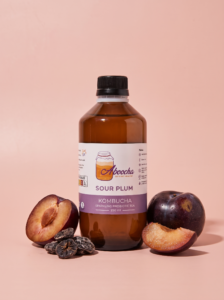
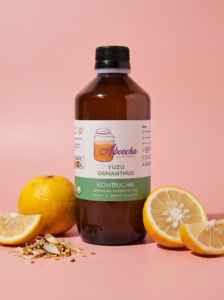
We have not published a calorie-per-bottle figure in this article, because we do not want to put a number here that is not on the pack in front of you. Check the nutrition panel on each product page, for example Sour Plum or Yuzu Osmanthus, and use the arithmetic above.
A raw kombucha should be kept cold. See how to store kombucha for why, and for how we ship. You can browse our kombucha in Singapore range, or go straight to the shop.
Sources and what we could not verify
Numbers in this article come from these sources, which we opened and read:
- Open Food Facts, product search for kombucha, first 60 records, reviewed on 15 October 2026. Statistics are our own calculations from the energy and sugar values per 100 mL.
- Open Food Facts record for Coca-Cola Original (barcode 5449000000996) and a second Coca-Cola record.
- Singapore Health Promotion Board, Nutri-Grade page, for the grading and front-of-pack labelling rules.
- Fermentation time and temperature in kombucha, Foods, 2026 (PMC13072973). Abstract read; it does not report calories.
- Kombucha as a bioactive functional beverage, International Journal of Molecular Sciences, 2026 (PMC13026228). Abstract read.
What we could not verify: an earlier version of this article quoted a calorie range and average from a marketing review. We could not open that source, and the study it was linked to measures flavour additives and antioxidants, not calories, so we removed those figures rather than repeat them. We also could not find a systematic review we could read that supports a weight-loss claim.
This article is general information, not medical advice. If you have diabetes or another condition that depends on how much sugar you drink, ask a doctor or dietitian.
How many calories are in kombucha per 100 mL?
In the 59 product label records we reviewed, kombucha ranged from 0 to 23 kcal per 100 mL, with a median of 14. Your bottle may differ, so use the figure on its label.
How many calories are in a bottle of kombucha?
Multiply the per 100 mL value by the volume and divide by 100. At the sample median, 330 mL is about 46 kcal and 500 mL is about 70 kcal. Sweet or juice-heavy bottles can reach 76 kcal at 330 mL or 115 kcal at 500 mL.
How many calories are in one cup of kombucha?
A cup is about 240 mL. At the sample median that is about 34 kcal, and at the highest value we saw it is about 55 kcal.
Is kombucha high in calories?
Usually no compared with a regular cola, which was 42.4 kcal per 100 mL on its label record. But sweet or large bottles can be much higher than a plain one, so read the label.
Is kombucha lower in calories than soda?
At the median, yes: about 46 kcal against about 140 kcal for 330 mL. The highest kombucha we saw, 76 kcal for 330 mL, was more than half the cola, so compare the specific bottle.
Does kombucha help with weight loss?
We did not find a trial showing that kombucha causes weight loss. Swapping a sweeter drink for a lower-calorie kombucha cuts calories, but that is simple substitution.
Why do kombucha calories vary so much?
Composition varies with fermentation conditions, and added juice or syrup and bottle size change the energy in the bottle. The sugar left after fermentation and anything added afterwards are the main drivers.
Does a Nutri-Grade mark tell me the calories?
No. Singapore's Health Promotion Board requires the mark on drinks graded C or D and makes it optional for A and B. The grade reflects nutrients of concern, not the calorie figure, so read the nutrition panel.