Kombucha is not a proven weight-loss agent. The best human trials show it doesn’t outperform diet alone for shedding pounds, but a low-sugar version can still help indirectly, replacing sugary drinks and modestly improving cholesterol and gut markers while you cut calories elsewhere.
TL;DR:
- Drinking low-sugar kombucha at 4 to 8 ounces daily can replace sugary drinks and support better cholesterol and gut health markers during calorie restriction.
- The 10-week human trial showed kombucha improved lipid markers and reduced visceral fat risk indicators but did not increase overall weight loss compared to diet alone.
- Benefits are formulation-dependent, with results applicable mainly to specific green tea kombucha at around 14 calories per 100 milliliters, not generic brands or flavored varieties.
- Kombucha’s potential metabolic effects are biologically plausible through gut microbiome shifts, polyphenol activity, organic acids, and behavioral calorie swaps, but no conclusive evidence confirms fat loss.
- Commercial kombucha often contains added sugar, alcohol, or sweeteners, so reading the label carefully is essential when using it as part of a weight management strategy.
Table of Contents
- What the Human Research Actually Shows About Kombucha and Weight Loss
- Why Animal Studies and Marketing Claims Don’t Prove Kombucha Causes Weight Loss
- How Kombucha Could Plausibly Support Metabolism
- How to Actually Drink Kombucha If Weight Management Is the Goal
- Why Aboocha’s Approach to Kombucha Holds Up to Scrutiny
- The Honest Take on Kombucha for Weight Management
- Try a Low-Sugar Kombucha Habit Without the Guesswork
- Sources
- FAQ
What the Human Research Actually Shows About Kombucha and Weight Loss
The strongest evidence on kombucha weight loss comes from a 10-week randomized controlled trial involving 59 adults with excess body weight. Participants followed a calorie-restricted diet, and half added 200 mL of green tea kombucha daily. Both groups lost roughly the same amount of weight. That single fact tends to disappoint people hoping kombucha would speed things up, but the story doesn’t end there.
Inside the kombucha group specifically, researchers measured meaningful drops in total cholesterol, LDL cholesterol, VLDL cholesterol, and triglycerides. The kombucha drinkers also showed a reduced lipid accumulation product, or LAP, a marker that estimates visceral fat risk better than body mass index alone. Gastrointestinal symptom scores improved too, which matters if bloating or irregularity has ever derailed your diet motivation.
Trial snapshot: Over 10 weeks, the kombucha group in this RCT saw improved lipid markers and reduced LAP scores, even though total weight loss matched the control group almost exactly.
A related analysis from the same research team looked at inflammation and salivary microbiota in the same population. That study found the kombucha group had a statistically significant LAP reduction (p = 0.029), improved oral microbiome diversity, and a lower Bacillota to Bacteroidota ratio, a ratio some researchers associate with leaner metabolic profiles. The kombucha group also showed a smaller rise in interleukin 6, an inflammatory marker that tends to climb during aggressive dieting.
A few points worth flagging before you get too excited:
- Both trials used the same 200 mL/day dose of a specific green tea kombucha formulation, not an arbitrary commercial bottle.
- Sample sizes were under 60 people, and both trials ran open-label, meaning participants knew what they were drinking.
- Ten weeks is long enough to see metabolic shifts but insufficient to confirm whether benefits hold up over longer periods.
None of that erases the findings. It just means you should read them as a promising signal, not a finished verdict.
Why Animal Studies and Marketing Claims Don’t Prove Kombucha Causes Weight Loss
A lot of kombucha marketing leans on preclinical research that never involved a human digestive system. Worm and animal-model studies have found that kombucha-associated microbes can trigger fasting-like intestinal responses that reduce lipid accumulation, an interesting mechanism, but one observed in invertebrates under lab conditions, not in people eating normal meals. Treating those results as proof of human fat loss is a stretch no legitimate researcher would make.
The bigger issue in the human trials is simpler: calorie restriction did almost all the work. Both the kombucha group and the control group were on the same reduced-calorie diet, and that’s what drove the weight loss in each. Kombucha appeared to influence secondary markers, cholesterol, inflammation, gut symptoms, without meaningfully increasing total fat loss on top of the diet itself.
There’s also a formulation problem. “Kombucha” on a supermarket shelf can mean wildly different things depending on:
- The tea base (green tea versus black tea versus flavored blends)
- Fermentation time and the specific SCOBY culture used
- Added sugar, juice, or sweeteners after fermentation
Pro Tip: If a study used green tea kombucha at a specific dose, results don’t automatically transfer to a black tea kombucha loaded with fruit juice. Read the label, not just the headline.
How Kombucha Could Plausibly Support Metabolism
Nobody has proven a direct mechanism linking kombucha to fat loss in humans, but a few pathways are biologically plausible and worth understanding before you decide how much stock to put in the drink.
- Gut microbiome and probiotics. Kombucha’s live cultures may shift gut bacteria composition in ways that influence energy extraction from food, appetite signaling, and low-grade inflammation. The salivary microbiota changes seen in the RCT hint at a broader ecosystem effect, though gut and mouth microbiomes aren’t identical.
- Polyphenol activity. Green tea kombucha carries epigallocatechin gallate (EGCG), a compound researchers have linked to activation of AMPK and SIRT1, two cellular pathways involved in fat metabolism. This is a hypothesized mechanism, not a confirmed one in kombucha specifically.
- Organic acids and glycemic effects. Fermentation produces acetic acid and other organic acids that may blunt post-meal blood sugar spikes, which is part of why some kombucha and blood sugar research shows promise for glucose control.
- The behavioral swap. This is the least glamorous mechanism and probably the most reliable one: replacing a 150-calorie soda with a 14-calorie kombucha, day after day, adds up to real caloric savings over weeks.
The catch running through all four mechanisms is potency; for example, pairing kombucha with other low-calorie functional shots can enhance benefits, as detailed in functional beverage practices and pairing guidance. A commercial bottle’s polyphenol content, acid levels, and live culture count vary by brand, batch, and even shelf time, so the “kombucha and metabolism” story is really a story about specific formulations, not the category as a whole.
How to Actually Drink Kombucha If Weight Management Is the Goal
The RCTs that produced positive metabolic markers used 100 to 200 mL per day, roughly 4 to 7 ounces, alongside an already reduced-calorie diet. That’s a reasonable starting range if you want to trial kombucha for weight-conscious reasons: not a full bottle three times a day, just a consistent daily serving you can sustain for weeks.
Before you buy, check the label for four things:
- Total sugar per 100 mL. This is the single biggest variable separating a helpful swap from a disguised soda. Aboocha Kombucha’s own guide to reading kombucha calories breaks down how to compare bottles fairly.
- Alcohol by volume. Raw, unpasteurized kombucha can carry trace alcohol from fermentation, usually under 0.5%, but worth knowing if you’re avoiding alcohol entirely.
- Pasteurization status. Pasteurized versions kill some live cultures but reduce the risk of over-fermentation in the bottle.
- Added juice or sweeteners. Fruit-forward flavors sometimes reintroduce the sugar the base kombucha avoided.
Pro Tip: Swap one sugary drink a day for a low-sugar kombucha and track your total daily calories for two weeks. That’s a cleaner test of whether kombucha helps than just adding it on top of your existing habits.
A few groups should check with a clinician before making kombucha a daily habit: pregnant people, immunocompromised individuals, and anyone on medications that interact with fermented foods or caffeine.
Why Aboocha’s Approach to Kombucha Holds Up to Scrutiny
Irwin Lee, who covers evidence-based nutrition trends for this publication, built this guide around trial data rather than category hype, and that same standard shapes how Aboocha Kombucha talks about its own products.
Some low-sugar kombucha lines are built around the principle the RCTs point to: less added sugar means the drink is more likely to function as a genuine calorie swap rather than a sweetened soda in disguise. A few resources worth checking before you buy:
- How to read kombucha calories fast, which explains the 14 kcal per 100 mL benchmark and how it compares to standard sodas.
- Why lower sugar matters for a breakdown of how residual sugar affects both taste and health claims.
- When to drink kombucha, covering the 4 to 8 ounce daily range referenced earlier in this guide.
These aren’t abstract claims. They’re the same label-reading habits the clinical trials implicitly demand of anyone trying to replicate their results at home.
The Honest Take on Kombucha for Weight Management
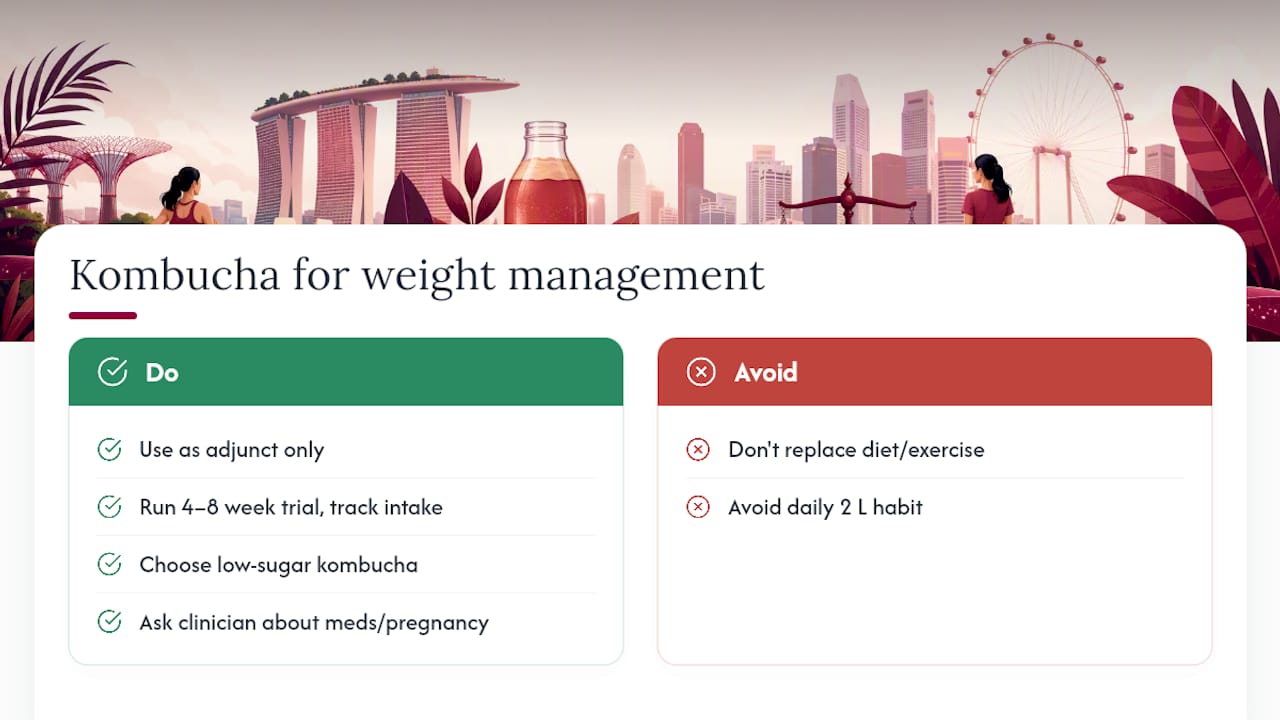
Kombucha earns a supporting role in a weight-management plan, not a starring one. The clearest evidence shows improved cholesterol markers, reduced LAP, and better gut symptoms, useful, but not a substitute for a calorie deficit or exercise.
If you want to test it honestly, run a 4 to 8 week trial with a consistent low-sugar kombucha, track your intake, and note any digestive changes. Bring questions about medications or pregnancy to a clinician first. Skip the daily two-liter habit; the trials that found benefits used modest, sustainable amounts, not excess.
— Irwin Lee
Try a Low-Sugar Kombucha Habit Without the Guesswork
Aboocha Kombucha builds every flavor around the same principle the research points to: lower sugar content so the drink works as a real calorie swap, not a sweetened treat wearing a health halo. Various kombucha flavors can provide variety without the sugar crash that undermines a weight-conscious routine.
Start small. Pick up a bundle to sample a few flavors, check the sugar content on each label using the same 100 mL benchmark covered above, and settle into a 4 to 8 ounce daily serving. If you land on favorites, an Aboocha Kombucha subscription plan keeps your fridge stocked without repeat ordering, and offices exploring a healthier pantry swap can look into corporate ordering for teams. Browse the current lineup and place your first order at Aboocha.
FAQ
Does kombucha help you lose weight?
Not on its own. Clinical trials show kombucha doesn’t add extra weight loss beyond calorie restriction, though it can help indirectly as a low-sugar replacement for sugary drinks and by improving cholesterol and inflammation markers.
What is the number one weight loss drink?
No single drink is proven to be the best for weight loss. Water, unsweetened tea, and low-sugar options like kombucha all support weight management mainly by replacing higher-calorie beverages, not through a unique fat-burning effect.
Does kombucha decrease your appetite?
There’s no strong human evidence that kombucha directly suppresses appetite. Its organic acids may blunt post-meal blood sugar spikes, which some people experience as steadier hunger levels, but this hasn’t been confirmed as an appetite-reduction mechanism.
What is the downside of kombucha?
Many commercial kombuchas carry hidden added sugar that can offset any benefit, and raw versions may contain trace alcohol from fermentation. Some people also experience gastrointestinal upset, and pregnant or immunocompromised individuals should check with a clinician before regular use.