Yes, kombucha can damage your teeth, and the mechanism is simple acid exposure. Kombucha typically sits at a pH of 2.5 to 3.5, well below the 5.5 threshold where enamel starts to soften, and lab studies confirm repeated exposure erodes it over time. The single biggest fix costs nothing: stop sipping it across hours and drink your serving in one sitting, then rinse with plain water. The rest of this article breaks down why that matters and what else protects your smile.
TL;DR:
- Drinking kombucha continuously throughout the day prolongs acid contact, increasing enamel erosion risk, especially for those with reduced saliva flow.
- Consuming kombucha in one sitting, rinsing with water afterward, and waiting 30 to 60 minutes before brushing can significantly minimize damage.
- Lower-sugar, calcium-fortified, or low-acid kombucha options can help reduce the erosive potential, but overall acidity remains a concern.
- People with dry mouth, autoimmune conditions, or on medications that decrease saliva are at higher risk for enamel erosion from kombucha.
- Staining from tea pigments can be addressed through professional cleanings or safe whitening, though eroded enamel limits whitening effectiveness.
Table of Contents
- How Kombucha Affects Your Teeth
- Who Faces the Highest Risk From Kombucha’s Acidity
- Your Practical Checklist for Protecting Your Teeth
- Why Kombucha Stains Teeth and What Actually Helps
- An Editorial Take on Kombucha’s Gut Benefits Versus Dental Risk
- A Lower-Sugar Way to Keep Enjoying Kombucha
- Sources
- FAQ
How Kombucha Affects Your Teeth
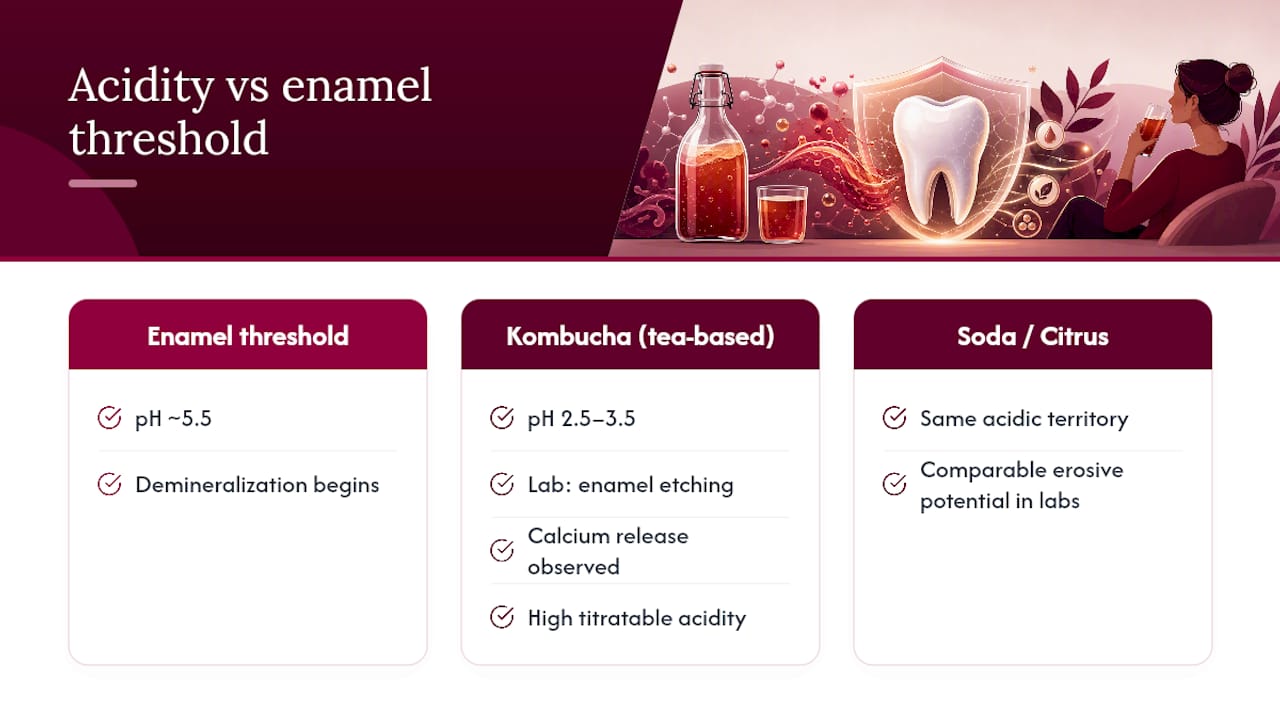
Enamel starts to demineralize once pH drops below about 5.5. Kombucha routinely measures between 2.5 and 3.5, which puts it in the same acidic territory as soda and citrus juice, and sometimes lower. That gap between kombucha’s acidity and enamel’s tolerance threshold is the entire story behind kombucha’s erosive potential shown in lab testing, where tea-based kombuchas caused measurable enamel etching and calcium release compared with control samples.
pH alone doesn’t tell the whole story, though. Titratable acidity (TA), the amount of base needed to neutralize a drink’s acid, determines how long that acid keeps attacking your teeth after each sip. A drink can have a moderate pH but a high TA, meaning your saliva has to work much harder and longer to bring your mouth back to a safe range. Research using atomic force microscopy found that kombucha’s titratable acidity can rival or exceed cola’s, and after prolonged exposure, kombucha produced enamel demineralization comparable to cola in the same study.
A systematic review covering studies from 2013 through 2025 backs this up at scale. Looking at drinks marketed as “healthy,” including kombucha, the review found consistent evidence of measurable enamel softening or surface loss across 38 eligible studies, with several kombucha samples matching or exceeding soda’s erosive potential in lab conditions.
Quick numbers to remember: Kombucha’s pH usually falls below the critical threshold for enamel demineralization, which begins around pH 5.5. This means kombucha is significantly more acidic than the threshold where your enamel starts to break down.
Who Faces the Highest Risk From Kombucha’s Acidity
Saliva is your natural defense system against acid. It buffers pH, washes away food particles, and helps redeposit minerals into enamel. When saliva production is reduced, that buffering capacity drops, and acidic drinks like kombucha get more time to work on your teeth before your mouth can neutralize them.
Several everyday factors can leave you with less saliva than you’d expect:
- Antihistamines, antidepressants, and blood pressure medications commonly reduce salivary flow.
- Sjögren’s syndrome and other autoimmune conditions directly target salivary glands.
- Head and neck radiation treatment can permanently lower saliva output.
- Simple dehydration, especially from exercise or hot climates, temporarily thins saliva’s protective effect.
People with existing dental restorations should also pay attention. Composite resin fillings aren’t immune to acid attack, and calcium loss from resin surfaces has been documented after kombucha exposure in lab settings. If you’re drinking flavored or sweetened kombucha varieties, bacteria in your mouth feed on that added sugar and produce their own acid, stacking a cavity risk on top of the erosion risk.
Your Practical Checklist for Protecting Your Teeth
You don’t have to give up kombucha to protect your smile. You just need to change how you drink it.
- Set a limit and stick to a single sitting. Continuous sipping throughout the day keeps your mouth in an acidic state for hours. Finishing a serving in ten or fifteen minutes gives your saliva a real chance to recover between exposures. This guidance on daily serving amounts offers a useful starting point for timing your intake.
- Use a straw when it’s practical. Directing kombucha toward the back of your mouth reduces contact time with your front teeth, where staining and erosion show up first.
- Rinse with plain water immediately after finishing. This simple step, backed by dental hygiene guidance on reducing acid contact time, helps wash residual acid off your enamel before it can do more damage.
- Wait 30 to 60 minutes before brushing. Brushing immediately after acid exposure can abrade enamel that’s still in a softened state. Give it time to reharden first.
- Chew sugar-free gum if you can’t brush right away. Stimulating saliva flow speeds up the neutralization process, and research on saliva stimulation supports this as an effective interim step.
- Choose fluoride toothpaste, and ask your dentist about a fluoride rinse. Also, consider switching to an eco-friendly option like a bamboo toothbrush to further protect your teeth and the environment. Fluoride helps remineralize enamel that’s already been softened by acid exposure.
- Favor lower-sugar, lower-acid kombucha varieties when you have the choice. Some manufacturers fortify their brews with calcium, and lab data shows calcium addition raises pH and reduces measured hardness loss in composite resin, a promising, though still limited, mitigation strategy.
Pro Tip: Keep a reusable water bottle nearby whenever you drink kombucha. Alternating a sip of kombucha with a sip of water dilutes acid contact in real time, and it turns rinsing into a habit instead of an afterthought.
See a dentist if you notice ongoing sensitivity to cold or sweet foods, visible changes in enamel texture or thinness, or staining that seems to be getting worse despite brushing. Those are signs your enamel may need professional attention rather than a home fix.
Why Kombucha Stains Teeth and What Actually Helps
Kombucha’s staining comes from the tea it’s brewed with. Black and oolong teas carry tannins and other pigments that cling to enamel’s porous surface, and once acid exposure softens that surface, those pigments bind even more easily. That’s why kombucha drinkers sometimes notice staining that seems to worsen faster than what they’d expect from coffee or wine alone.
Your options for addressing it fall into two clear categories:
- Surface stains respond well to professional cleanings and whitening toothpastes formulated for enamel-safe polishing rather than aggressive bleaching.
- Deeper discoloration sometimes needs dentist-supervised bleaching, which uses higher-concentration whitening agents than anything sold over the counter.
- Heavily eroded enamel can limit how well whitening works, since thinner enamel lets the yellower dentin underneath show through more prominently.
If your enamel has taken real acid damage, a dentist can tell you whether whitening will actually deliver the result you’re picturing, or whether restoring enamel thickness should come first.
An Editorial Take on Kombucha’s Gut Benefits Versus Dental Risk
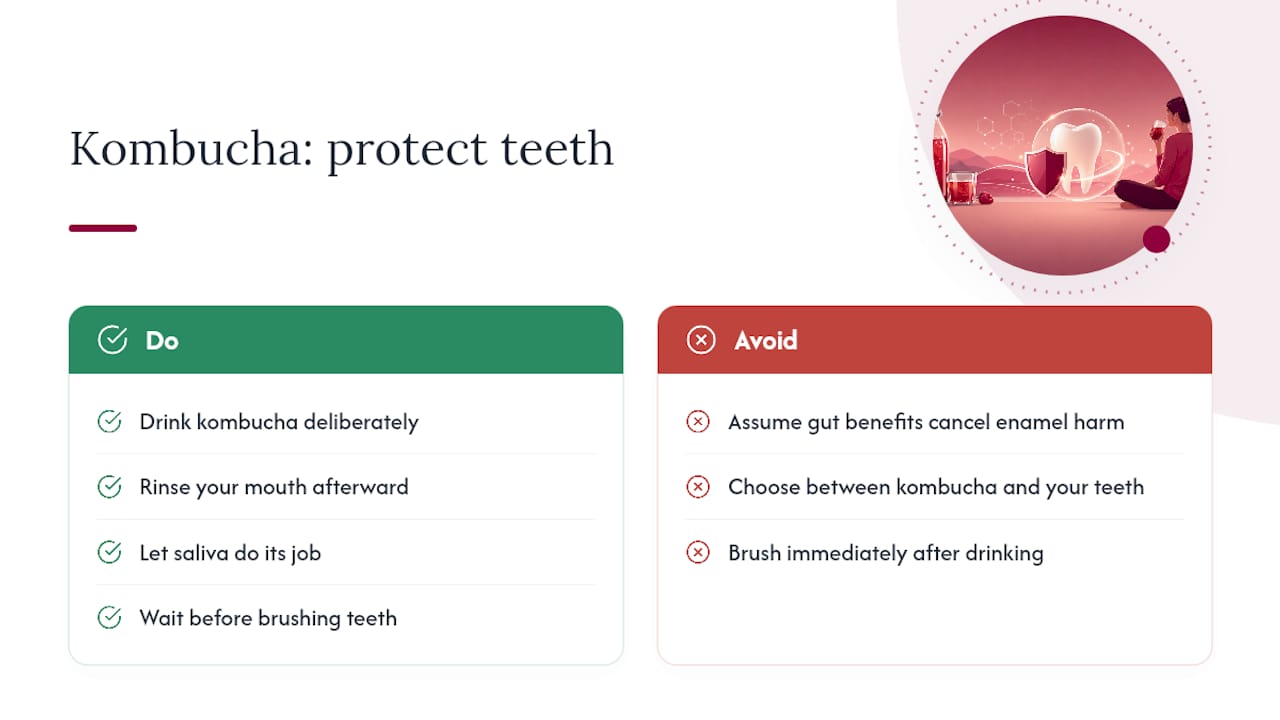
Kombucha’s fermentation benefits for digestion are real, and Aboocha Kombucha’s lower-sugar approach reduces one layer of risk that flavored, syrupy kombuchas add on top of acidity. But no amount of gut-health upside cancels out what pH and titratable acidity do to enamel over months of daily drinking.
The smartest approach isn’t choosing between kombucha and your teeth. It’s treating kombucha the way you’d treat citrus juice: enjoy it, but drink it deliberately, rinse afterward, and let your saliva do its job before you reach for a toothbrush.
— Irwin Lee
A Lower-Sugar Way to Keep Enjoying Kombucha
The idea behind some kombucha brands is that flavor-forward kombucha doesn’t need heavy sugar to taste good. Flavors like Sour Plum and Yuzu Osmanthus lean on real fruit and botanical notes instead of syrup, which matters for your teeth because sugar left in your mouth feeds the bacteria that produce their own acid on top of kombucha’s natural acidity.
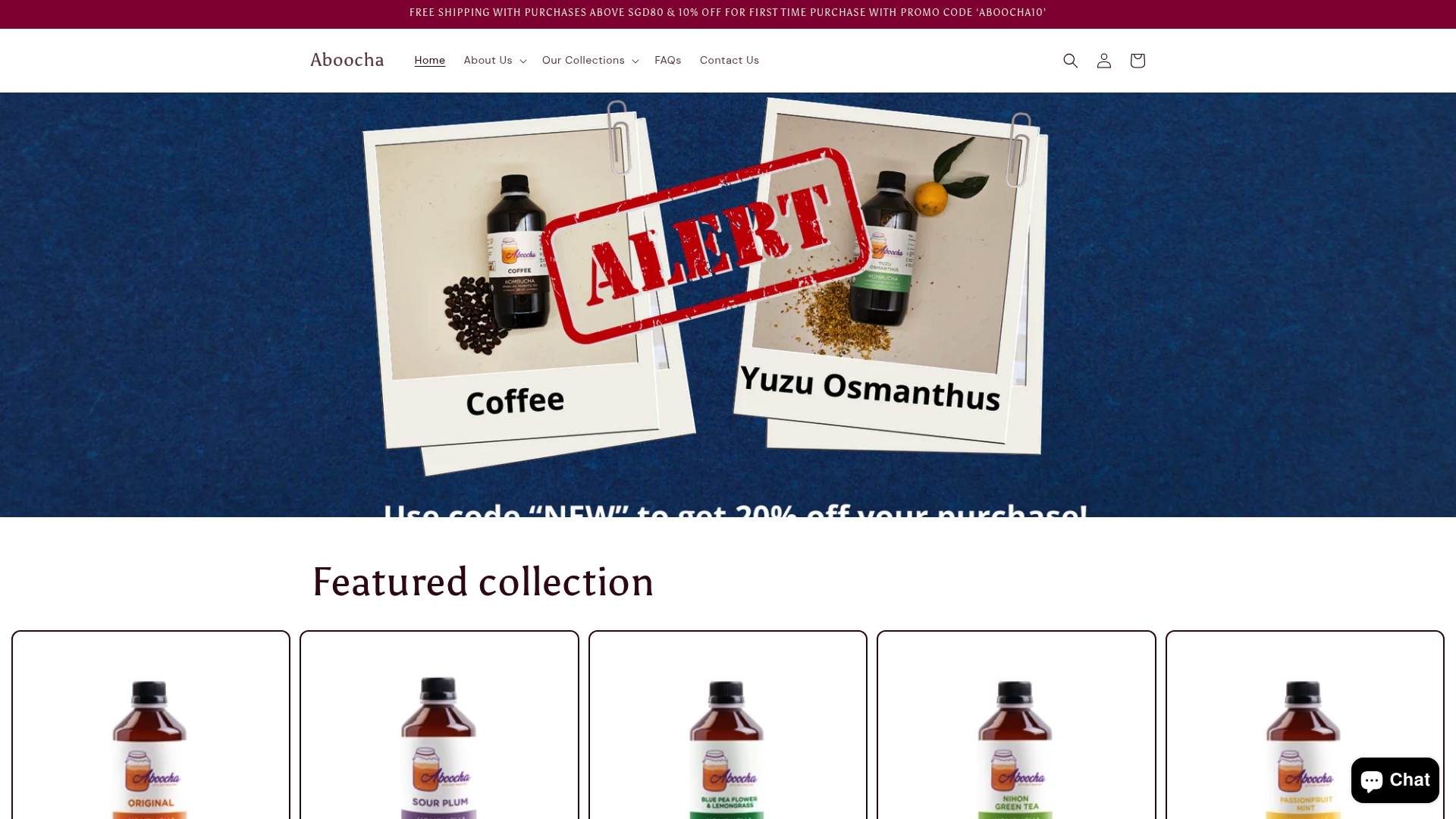
Pairing a lower-sugar bottle with the habits above, drink it in one sitting, rinse with water, wait before brushing, gives you a realistic way to keep kombucha in your routine without piling on unnecessary risk. If you’re curious about the flavor lineup, browse the full Aboocha Kombucha collection to find a variety that fits your taste. Prefer a steady supply without reordering every week? The Subscription Plan delivers bottles on a schedule you set. And if you’re stocking a break room or planning an event, the Corporate Orders & Pantry System makes bulk ordering simple.
This article is general information, not a substitute for advice from a qualified doctor. Consult a qualified healthcare professional about your own circumstances before acting on anything here.
Sources
- Erosive potential of ice tea beverages and kombuchas – PubMed
- Erosive impact of acidic ‘healthy’ beverages on dental enamel: A systematic review (2013–2025)
- Investigating the demineralisation of hydroxyapatite by kombucha and hard seltzer using atomic force microscopy
- Effects of kombucha on composite resin and the protective effect of added calcium
FAQ
Does Drinking Kombucha Affect Your Teeth?
Yes. Kombucha’s pH typically falls between 2.5 and 3.5, well below the point where enamel starts to soften, and lab studies confirm measurable erosion with repeated exposure. The risk grows with frequency and sipping duration, not from an occasional glass.
Is There a Downside to Drinking Kombucha?
Beyond its digestive benefits, kombucha’s acidity can erode enamel over time, and tea-derived pigments can stain teeth. Flavored or sweetened varieties add a cavity risk on top of that, since sugar feeds bacteria that produce additional acid.
Can Yellow Teeth Turn White Again?
Surface staining from tea pigments often responds to professional cleaning or enamel-safe whitening toothpaste. Deeper discoloration may need dentist-supervised bleaching, and heavily eroded enamel can limit how bright your results look since thinner enamel lets more of the yellow dentin underneath show through.
What Should I Drink to Avoid Tooth Decay?
Water remains the safest option between meals since it has a neutral pH and no fermentable sugar. If you want kombucha as part of your routine, choosing a lower-sugar variety and following it with a water rinse meaningfully reduces the combined acid and sugar exposure.
Does Aboocha Kombucha Cost Less Sugar Come With a Trade-Off?
Aboocha Kombucha’s lower-sugar formulation reduces the bacterial fuel that compounds acid exposure, though the base acidity common to all kombucha still applies. Pricing for individual bottles, flavor sets, and subscriptions is available directly on the Aboocha Kombucha site.